Paintings


Meine Maltechnik: Kremer Pigmente in Mohnöl und Schmincke Ölfarben lasierend in einer Gel-Öl-Wisch-Misch-Technik 

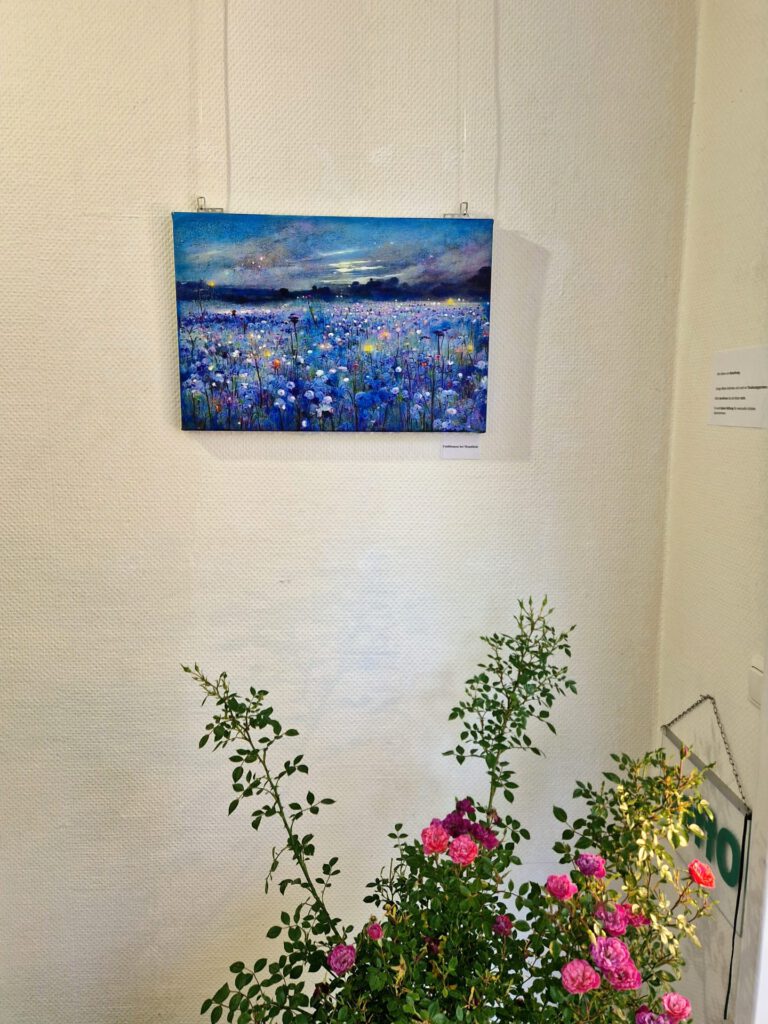
Blue Moon – The full moon will appear once again on 31 May 2026, and that’s not all – this time it will be particularly close to Earth, making it appear larger and brighter. As a Blue Supermoon, it will shine brightly in the night sky.

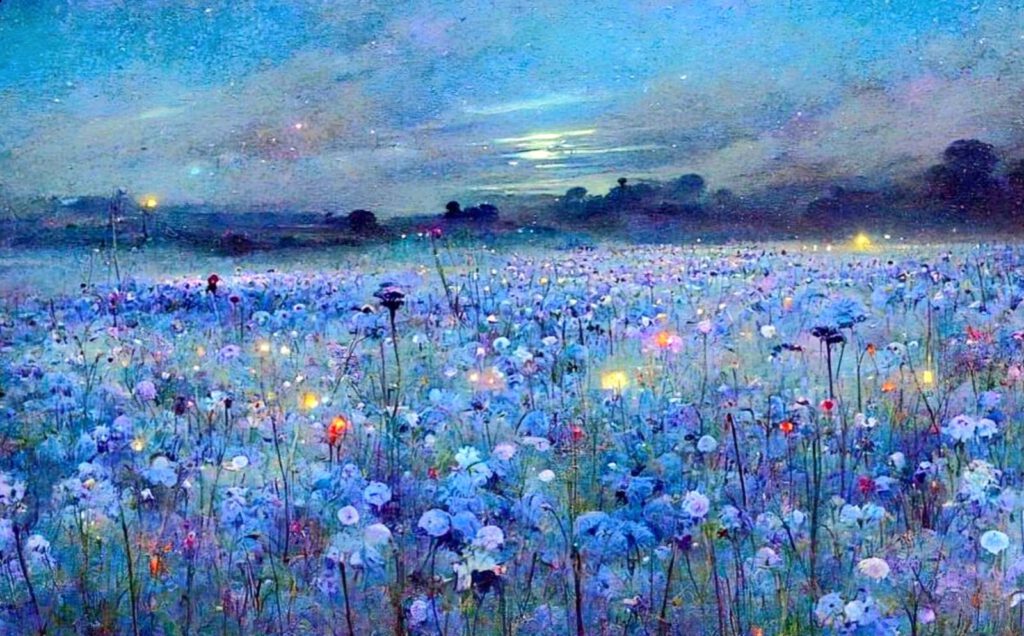
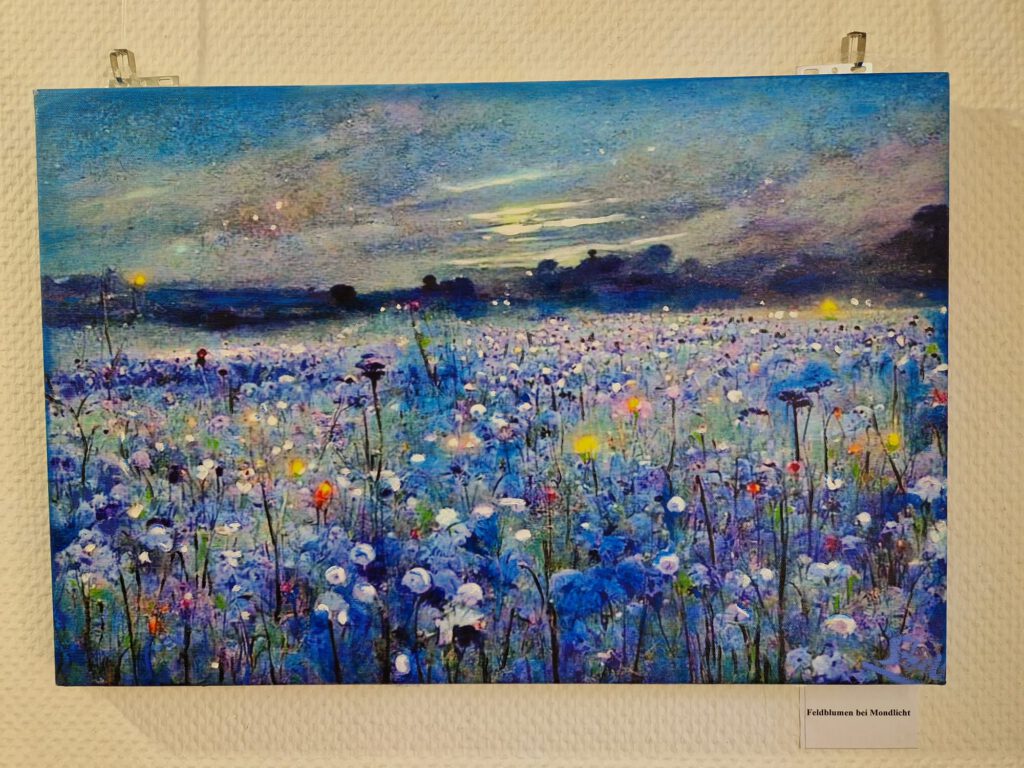
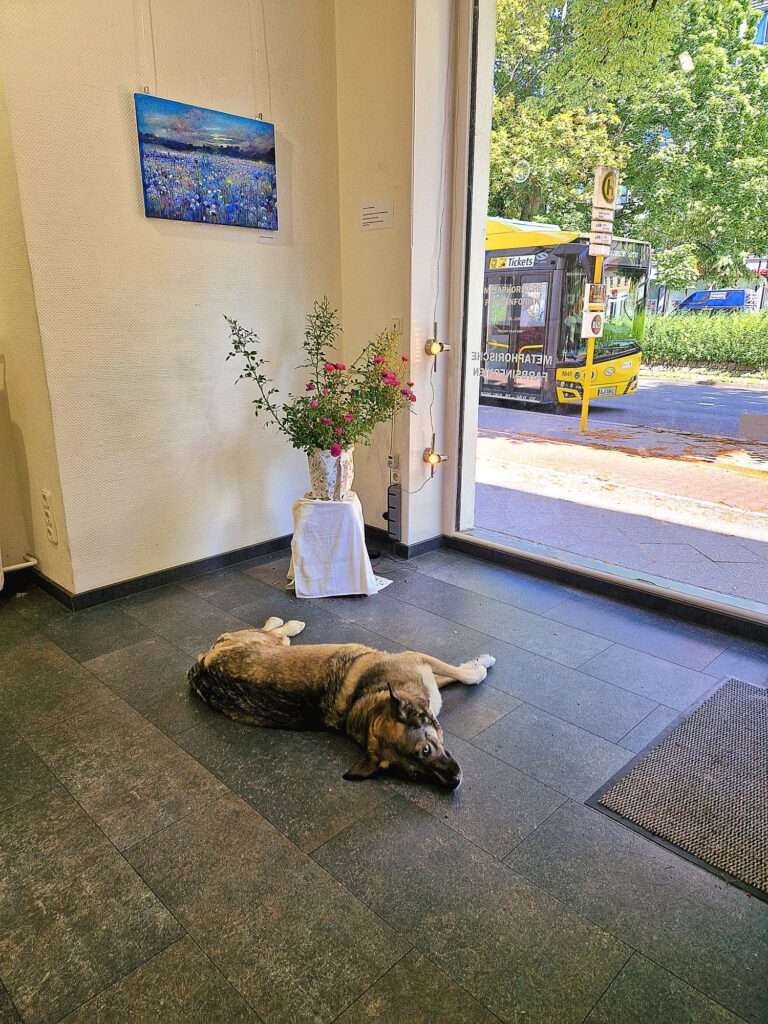
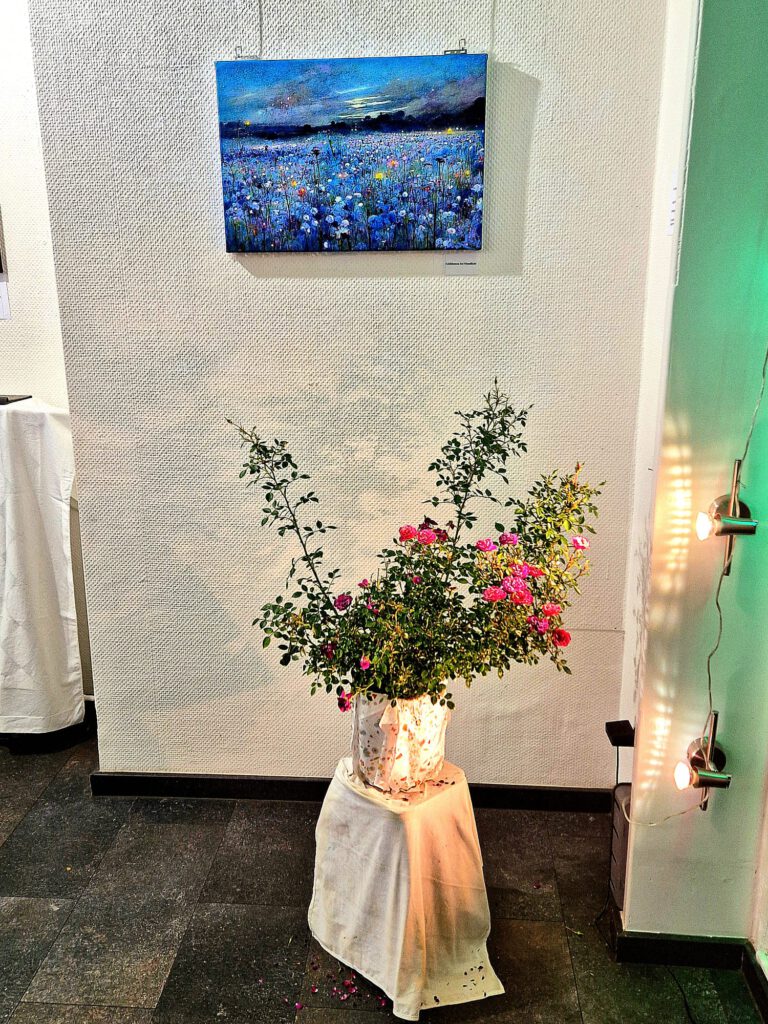
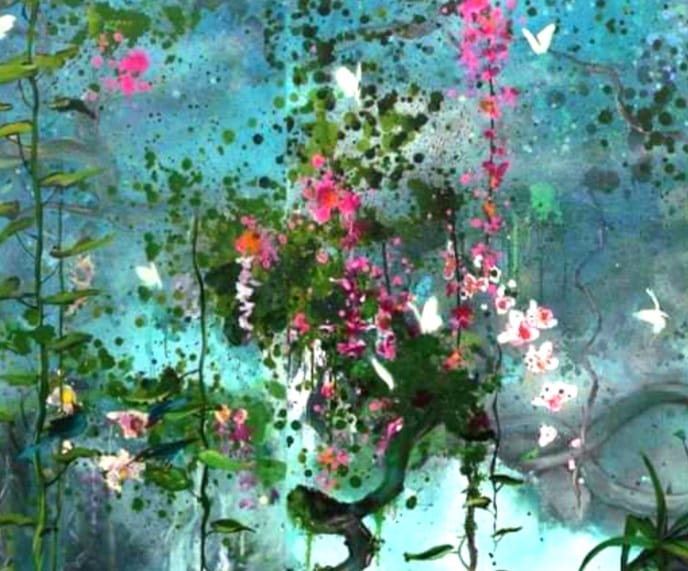
Wildflowers in the moonlight

Öl-Wisch-Misch-Technik, 40 x 60

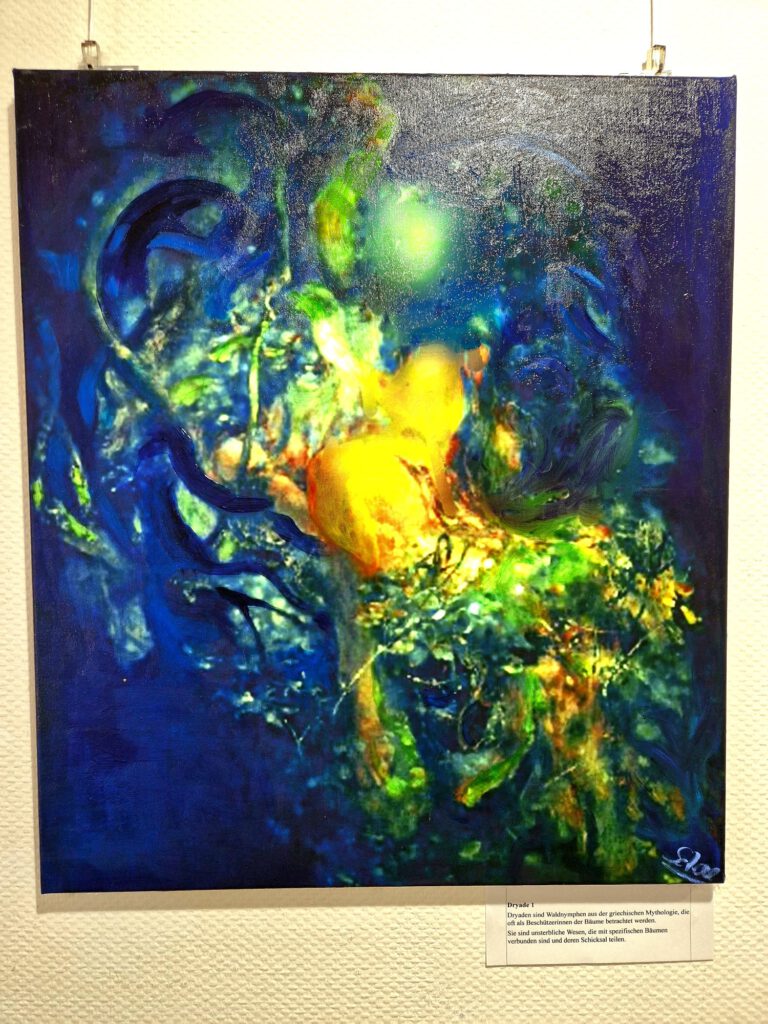
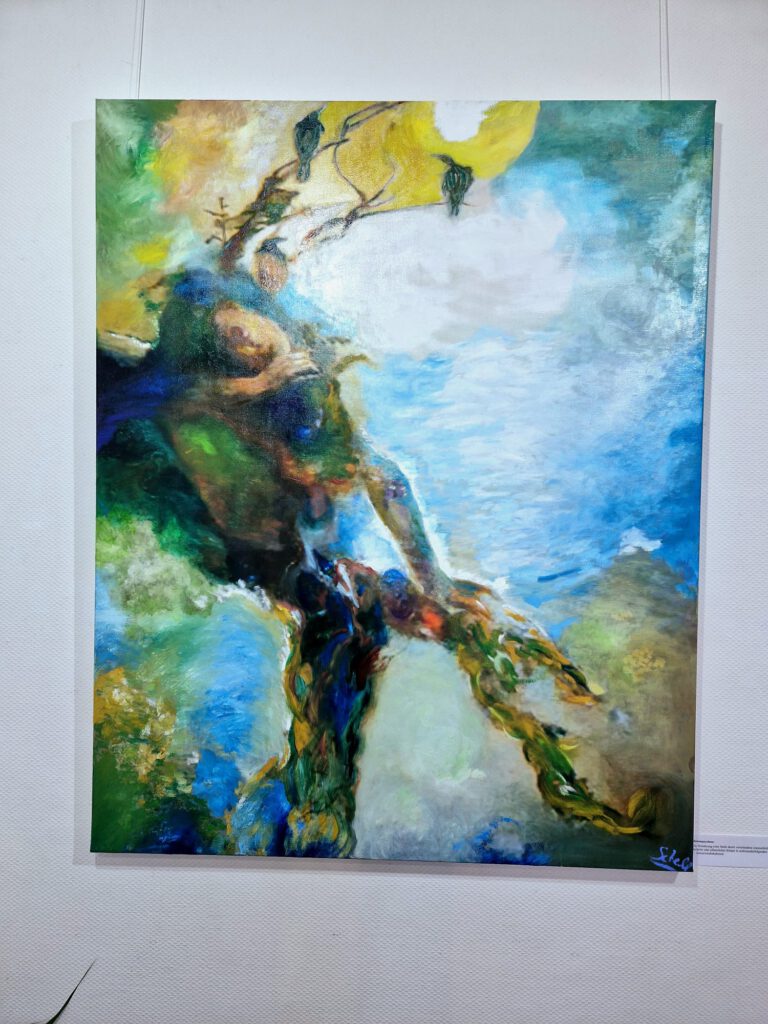
Dryade 1

Dryads are forest nymphs from Greek mythology who are often regarded as the guardians of trees.

Sie sind unsterbliche Wesen, die mit spezifischen Bäumen verbunden sind und deren Schicksal teilen.

Öl-Wisch-Misch-Technik, 70 x 60

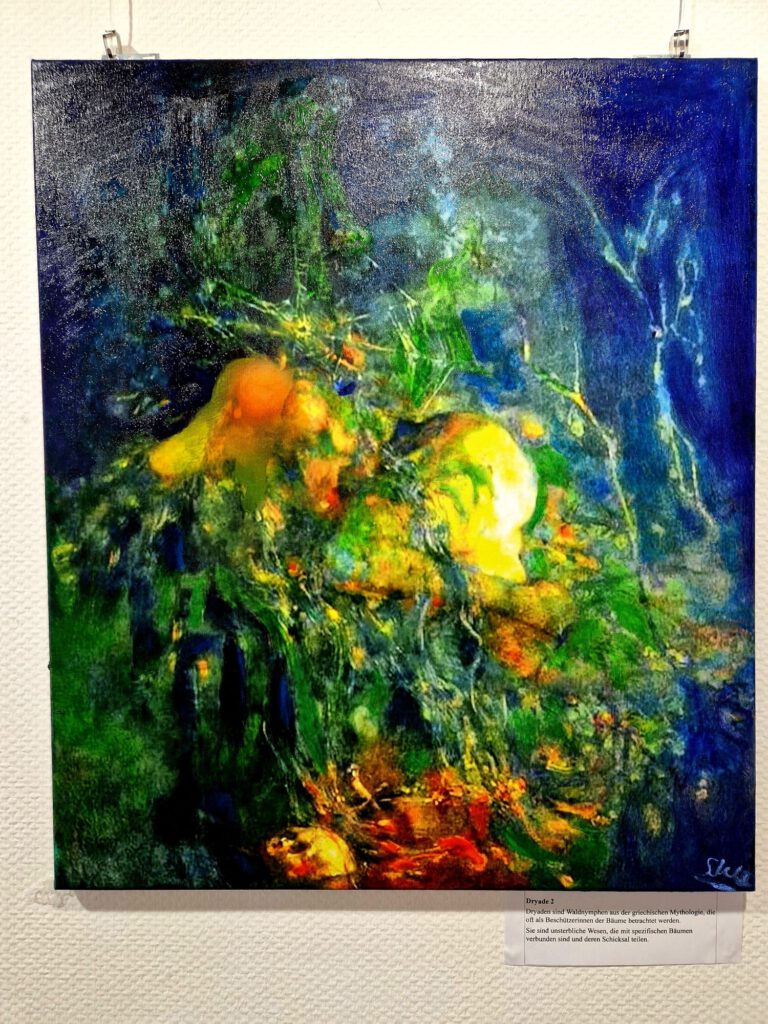
Dryade 2

Dryads are forest nymphs from Greek mythology who are often regarded as the guardians of trees.

Sie sind unsterbliche Wesen, die mit spezifischen Bäumen verbunden sind und deren Schicksal teilen.

Öl-Wisch-Misch-Technik, 70 x 60

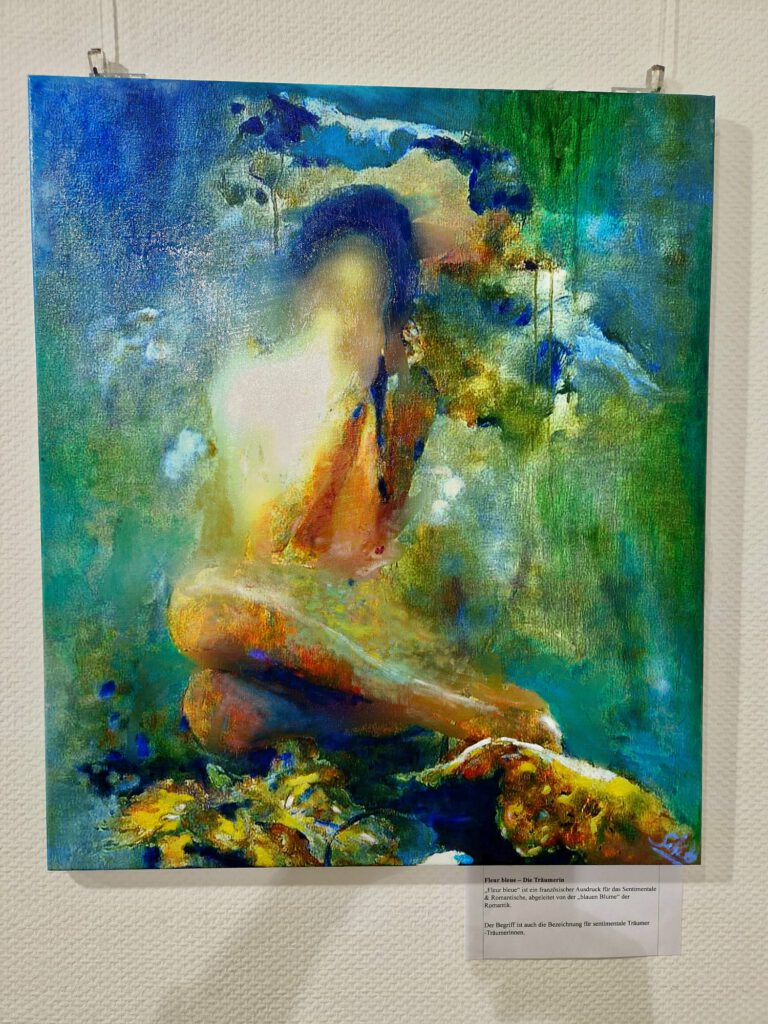
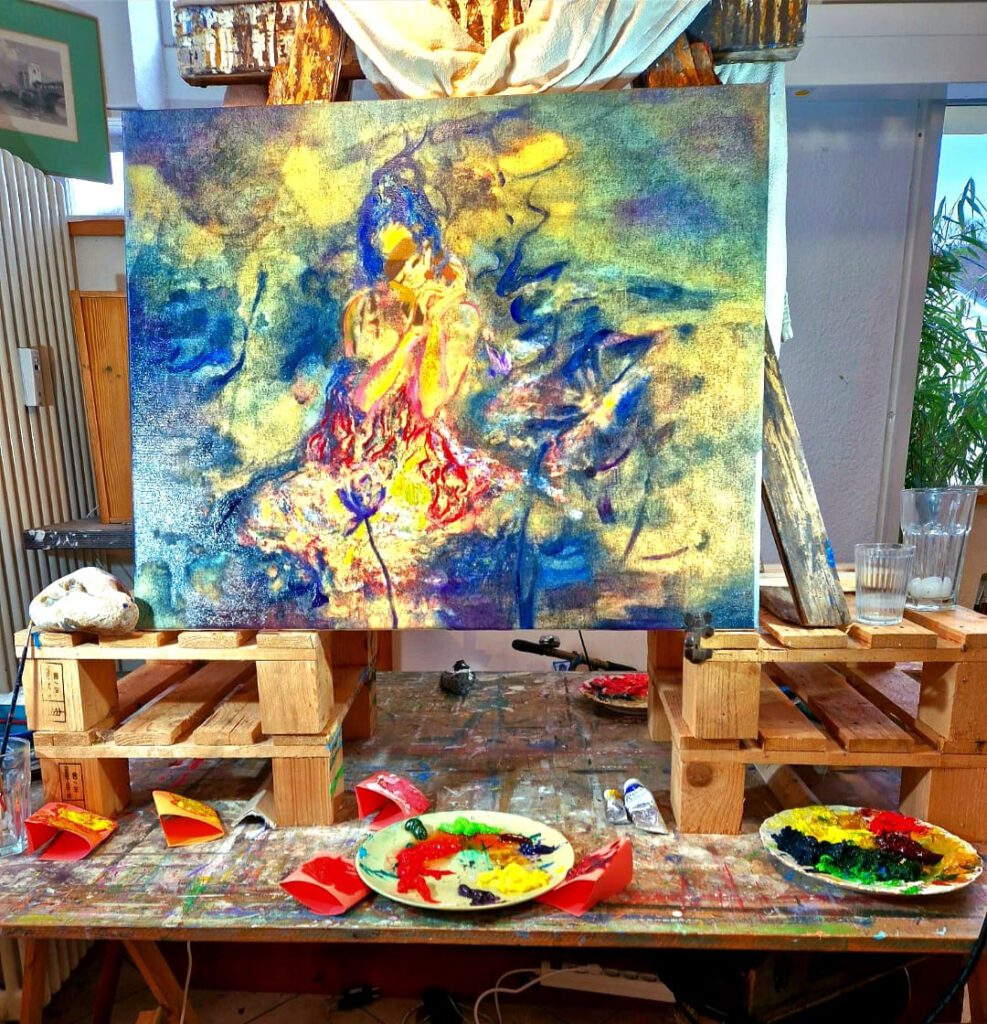
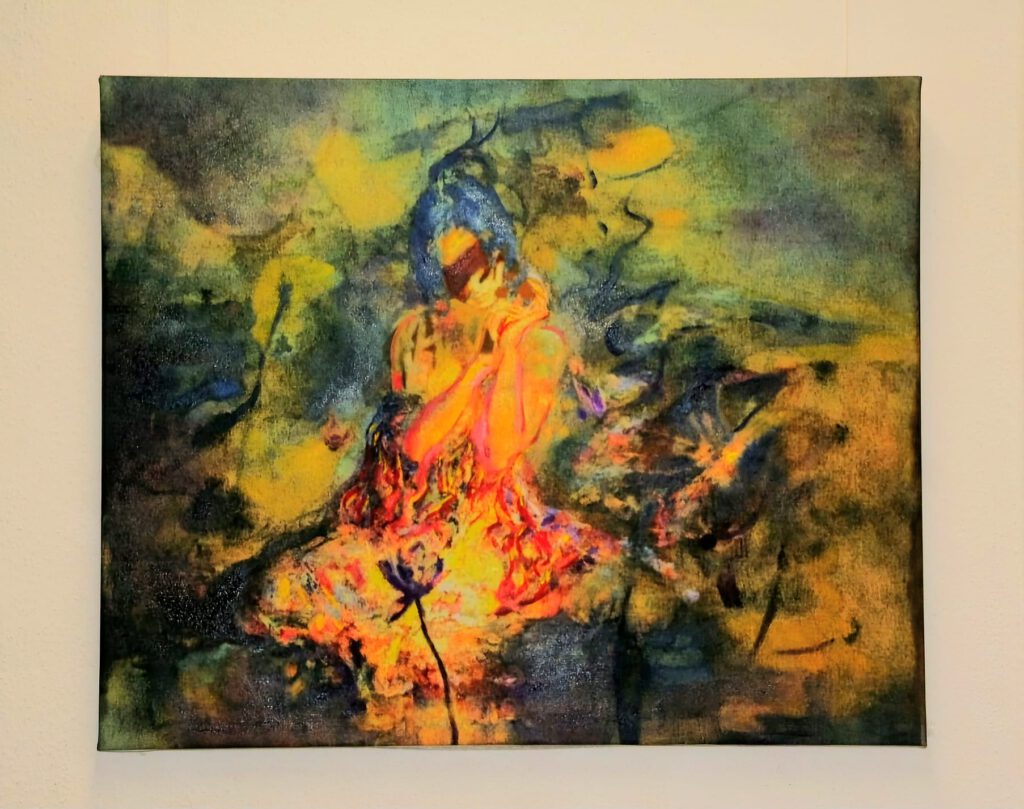
Fleur bleue – Die Träumerin

Fleur bleue“ ist ein französischer Ausdruck für das Sentimentale & Romantische, abgeleitet von der „blauen Blume“ der Romantik.

Der Begriff ist auch die Bezeichnung für sentimentale Träumer -Träumerinnen.


Öl-Wisch-Misch-Technik, 70 x 60

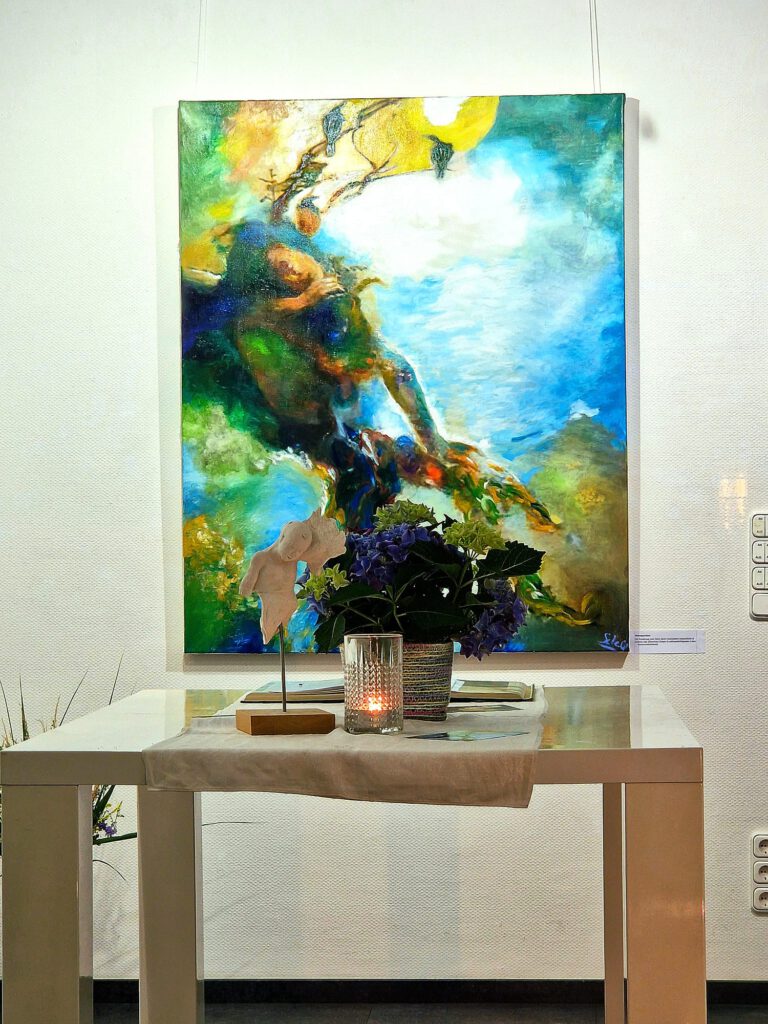
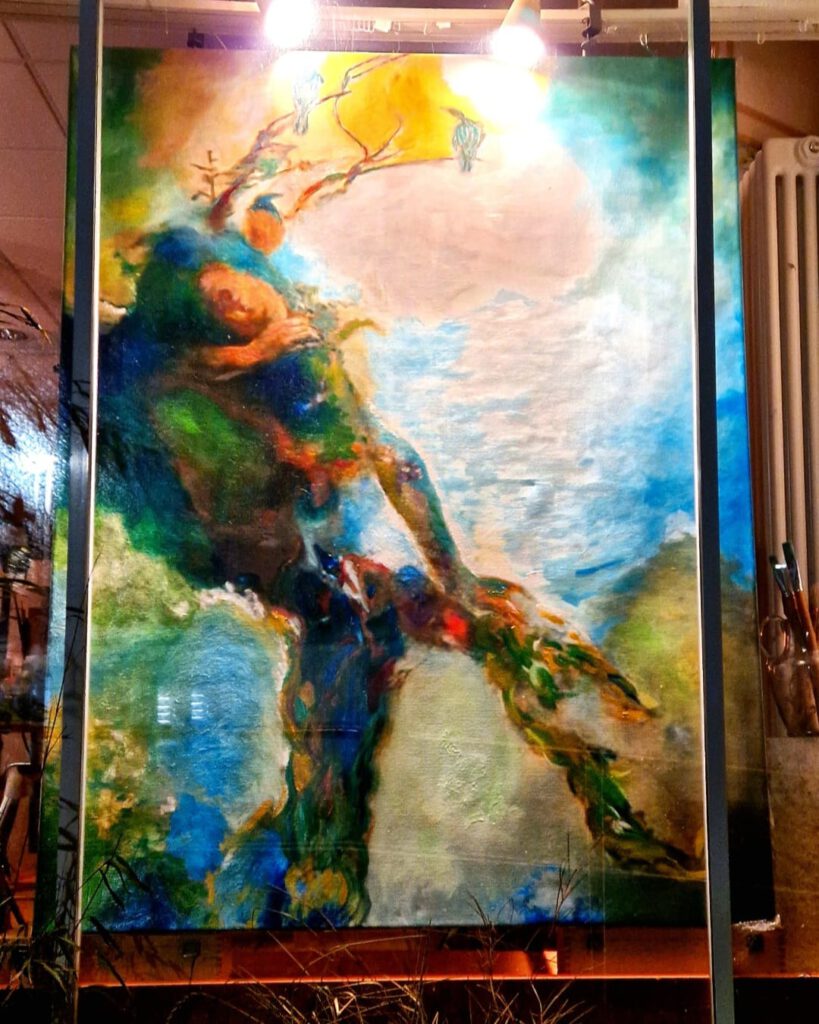
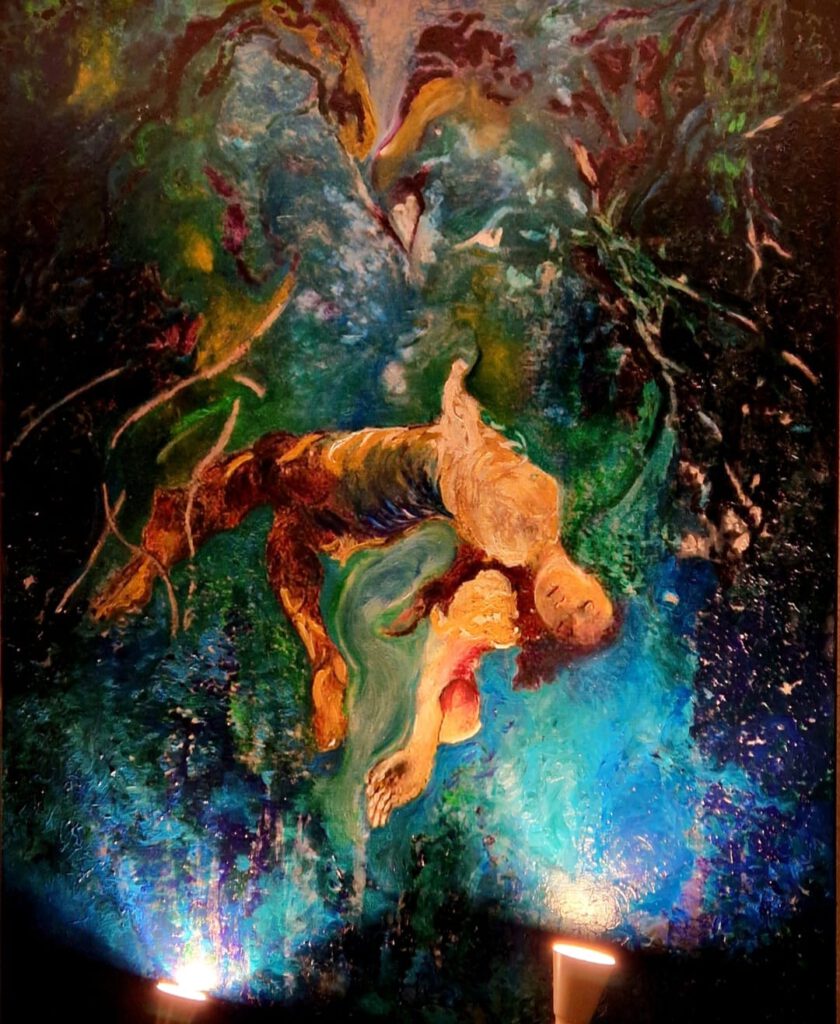
Metempsychose

Die Wanderung einer Seele durch verschiedene (menschliche & tierische oder pflanzliche) Körper in aufeinanderfolgenden Leben … immerwiederkehrend.

Ölmalerei,  120 x 150 

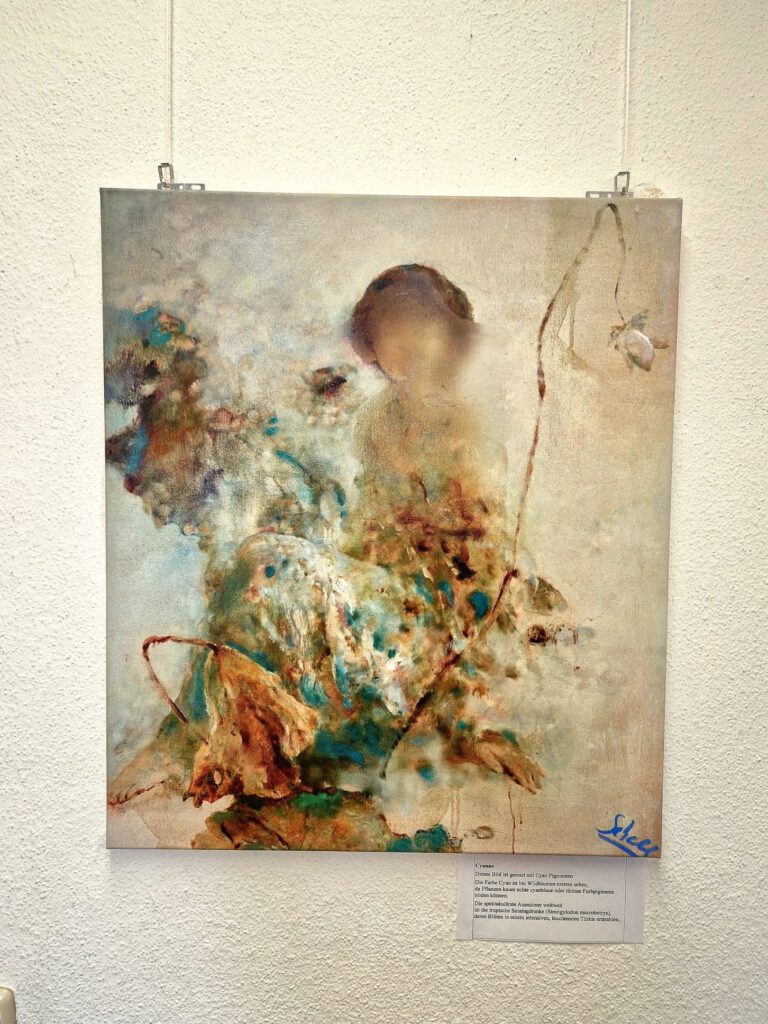
Cyanne

Dieses Bild ist gemalt mit Cyan Pigmenten

Die Farbe Cyan ist bei Wildblumen extrem selten, da Pflanzen kaum echte cyanblaue oder türkise Farbpigmente bilden können.

Die spektakulärste Ausnahme weltweit ist die tropische Smaragdranke (Strongylodon macrobotrys), deren Blüten in einem intensiven, leuchtenden Türkis erstrahlen.

Öl-Wisch-Misch-Technik, 70 x 60

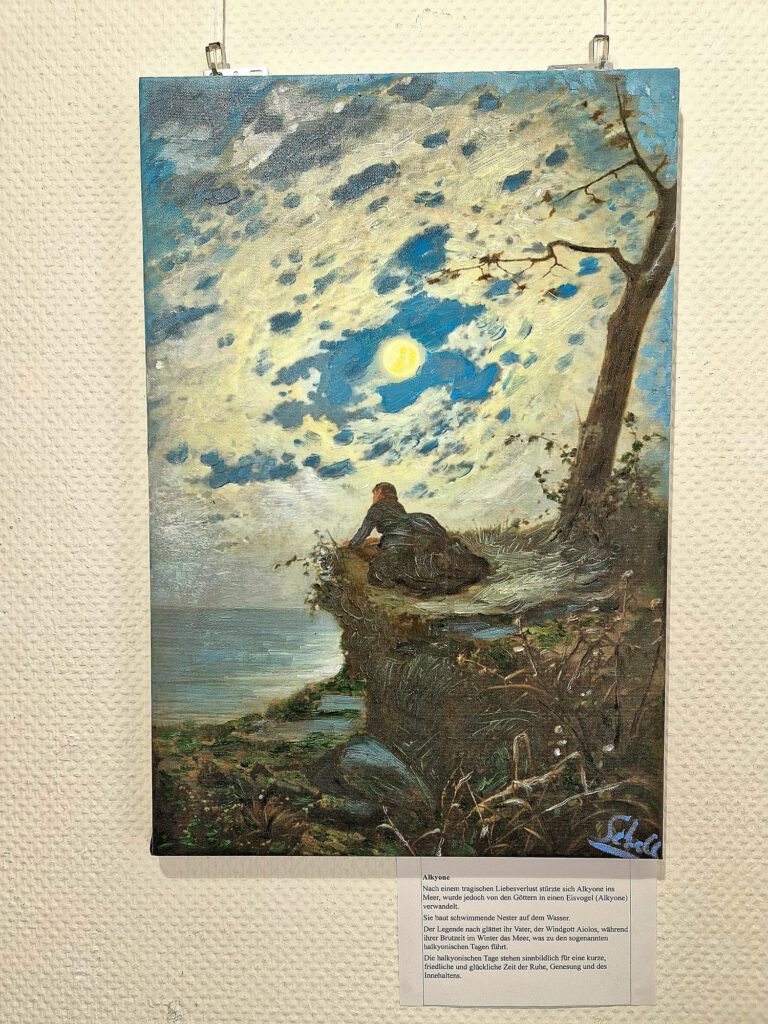
Alkyone

Nach einem tragischen Liebesverlust stürzte sich Alkyone ins Meer, wurde jedoch von den Göttern in einen Eisvogel (Alkyone) verwandelt.

Sie baut schwimmende Nester auf dem Wasser.

Der Legende nach glättet ihr Vater, der Windgott Aiolos, während ihrer Brutzeit im Winter das Meer, was zu den sogenannten halkyonischen Tagen führt.

Die halkyonischen Tage stehen sinnbildlich für eine kurze, friedliche und glückliche Zeit der Ruhe, Genesung und des Innehaltens.

Öl-Wisch-Misch-Technik, 60 x 40

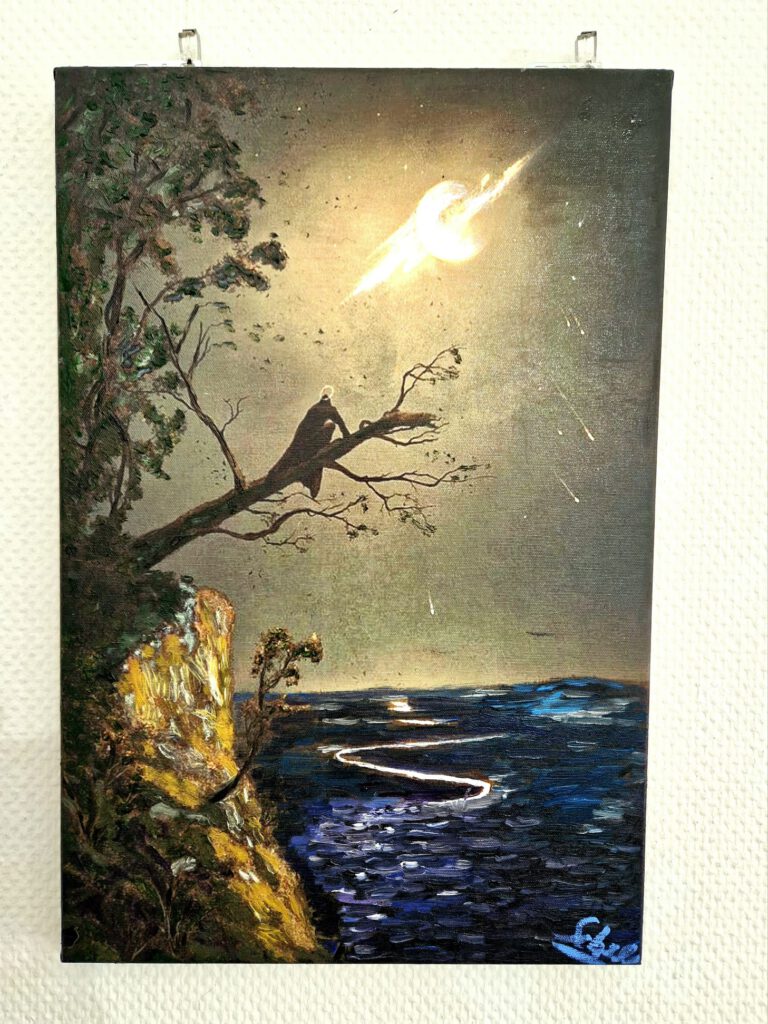
Komet

Öl-Wisch-Misch-Technik, 60 x 40

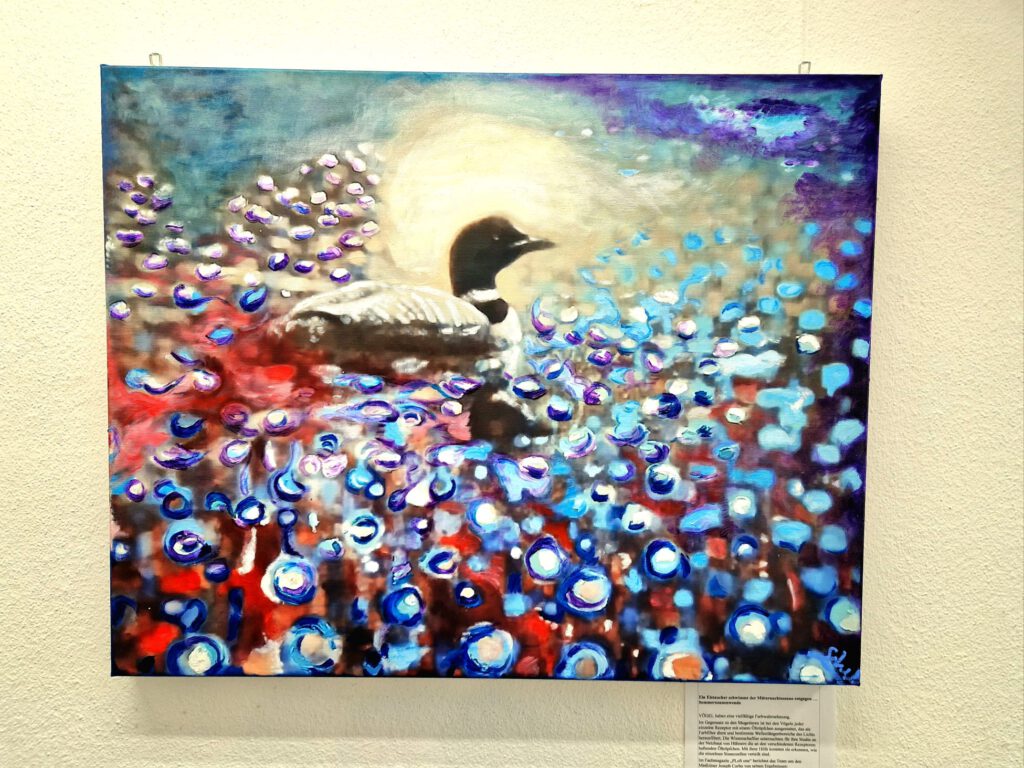
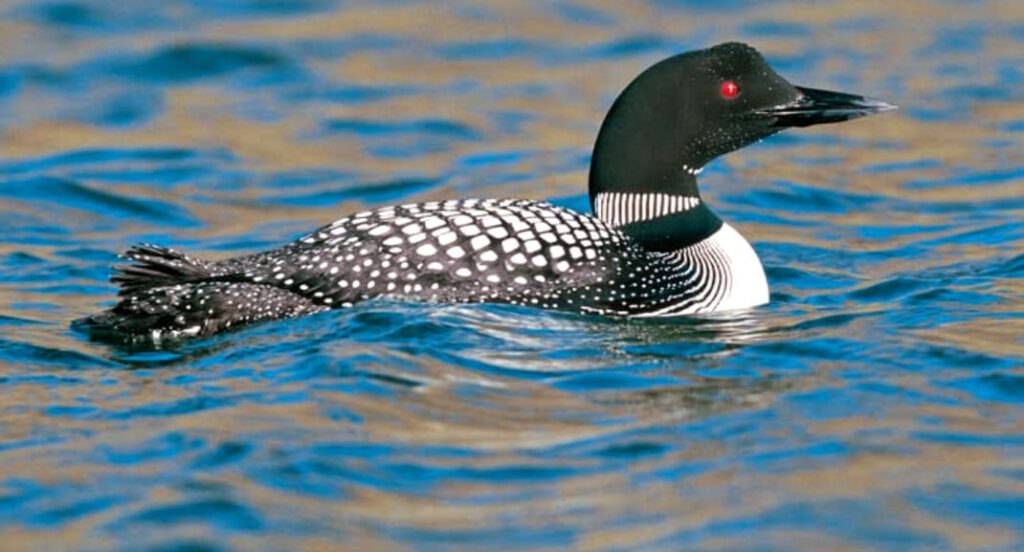
Ein Eistaucher schwimmt der Mitternachtssonne entgegen … Sommersonnenwende


VÖGEL haben eine vielfältige Farbwahrnehmung.

Im Gegensatz zu den Säugetieren ist bei den Vögeln jeder einzelne Rezeptor mit einem Öltröpfchen ausgestattet, das als Farbfilter dient und bestimmte Wellenlängenbereiche des Lichts herausfiltert. Die Wissenschaftler untersuchten für ihre Studie an der Netzhaut von Hühnern die an den verschiedenen Rezeptoren haftenden Öltröpfchen. Mit ihrer Hilfe konnten sie erkennen, wie die einzelnen Sinneszellen verteilt sind.

Im Fachmagazin „PLoS one“ berichtet das Team um den Mediziner Joseph Corbo von seinen Ergebnissen:

Neben den auch beim Menschen vorhandenen Rezeptoren zur Wahrnehmung von Rot, Grün und Blau kommt bei Vögeln noch ein Rezeptor für Violett hinzu. Seine Empfindlichkeit reicht bis in den ultravioletten Bereich hinein. Außerdem verfügen die Tiere noch über einen speziellen Rezeptor zur Wahrnehmung von Bewegungen.

Wenn wir die Vielfalt der Farben in der Natur jemals verstehen wollen, müssen wir zweifelsohne auch verstehen, wie sich die Tierarten in ihrer Farbwahrnehmung unterscheiden“

Ölmalerei, 100 x 80


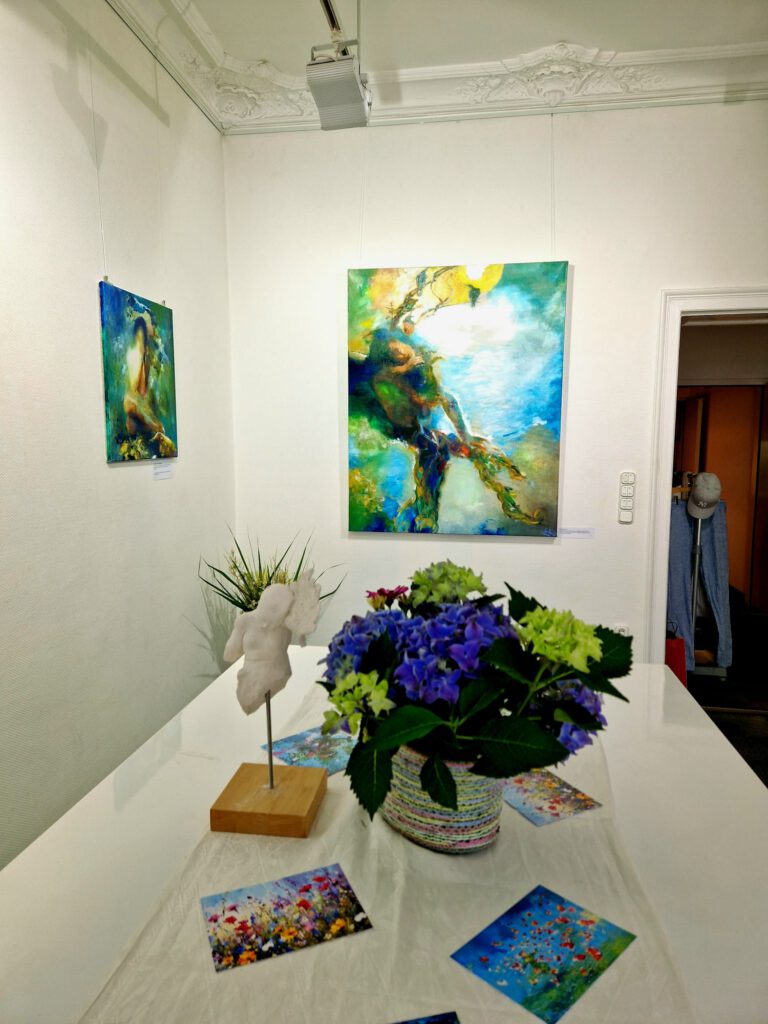
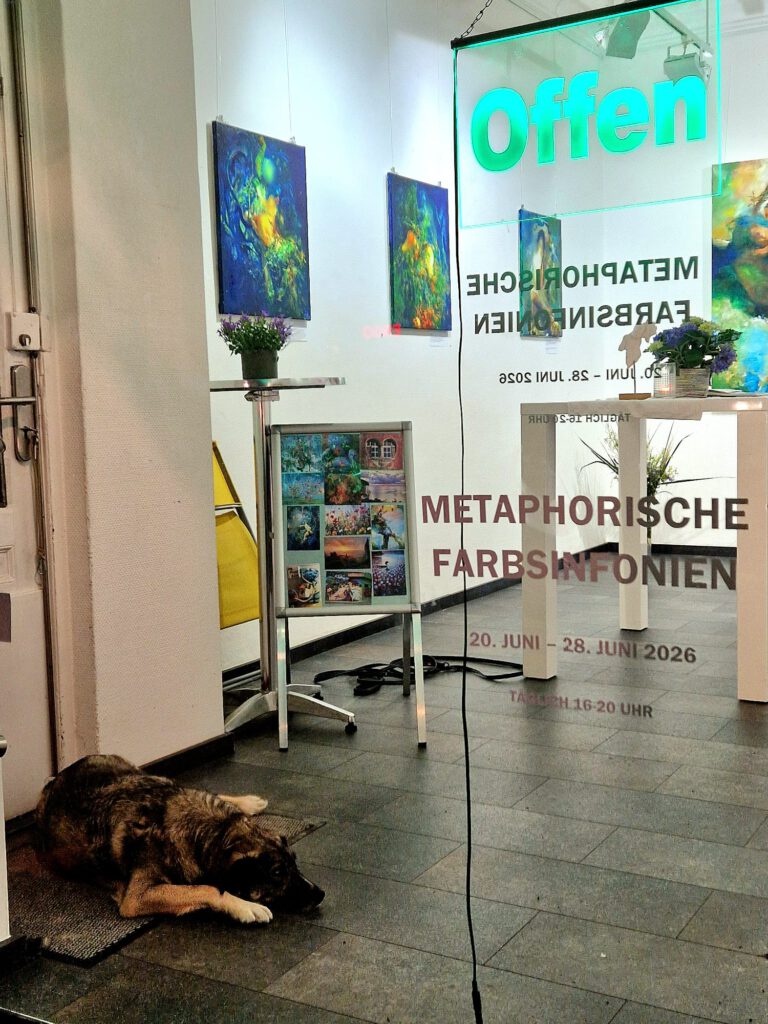
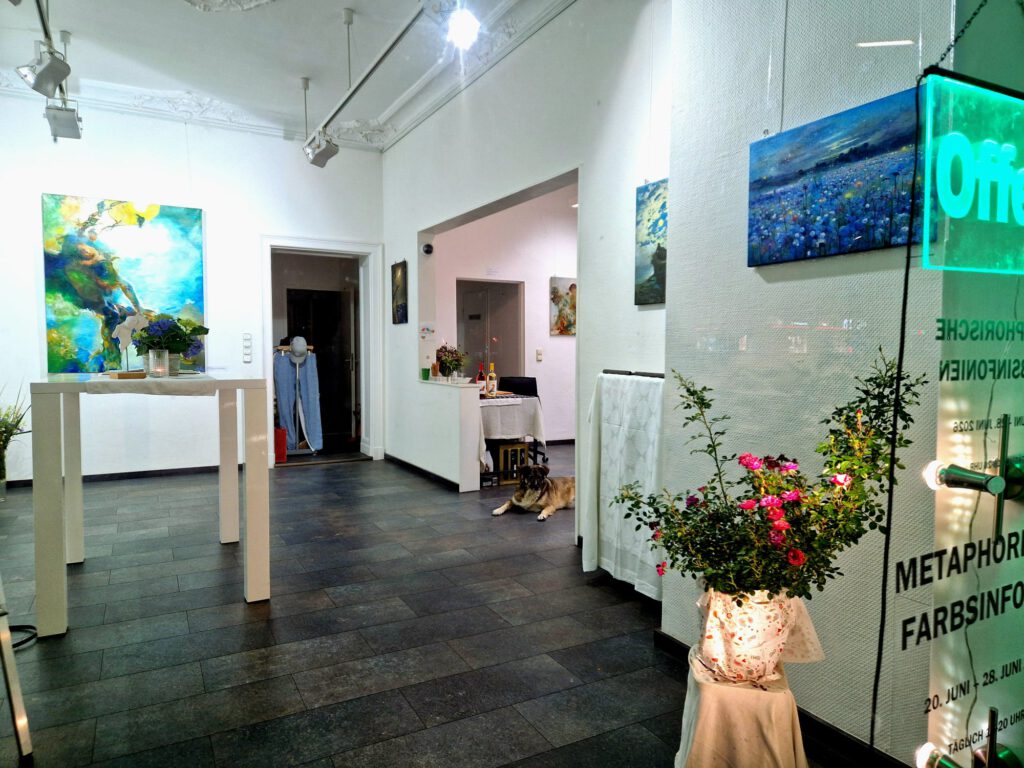
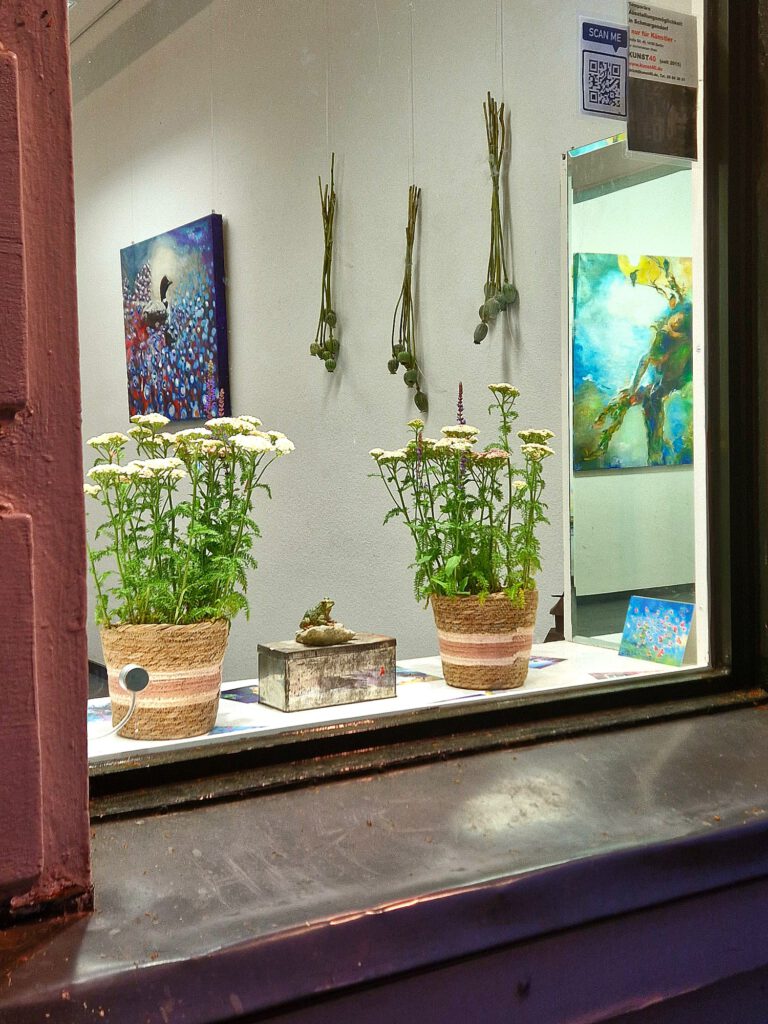
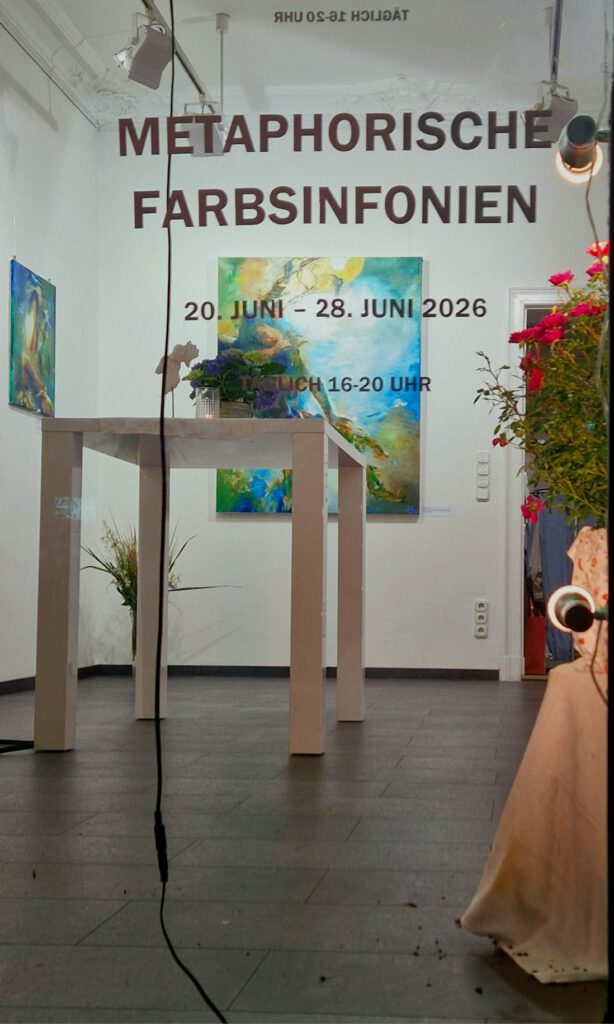
Alle Bilder waren zu sehen in meiner Ausstellung „Metaphorische Farbsinfonien“ im Juni 2026 in Berlin-Schmargendorf

https://www.kunst40.de/aktuell-vorschau/metaphorische-farbsinfonien/

Picture in the studio entrance area: Metempsychosis – my soul tree

The best beginning to a novel ever, in my opinion

The image is called metempsychosis: the wandering of a soul through different (human & animal or plant) bodies in successive lives... recurring. Like a time travel ... WritingArt with soul access:

"It was the best of times, it was the worst of times, it was the age of wisdom, it was the age of stupidity, it was the age of faith, it was the age of disbelief, it was the age of light, it was the age of darkness, it was the spring of hope, it was the winter of despair, we had everything ahead of us, we had nothing ahead of us, we were all going straight to heaven, we were all going straight the other way. -

In short, the time was so far like the present time that some of its loudest authorities insisted that it was received for good or for evil only by superlative comparison... "

- Charles Dickens, A Tale of Two Cities -


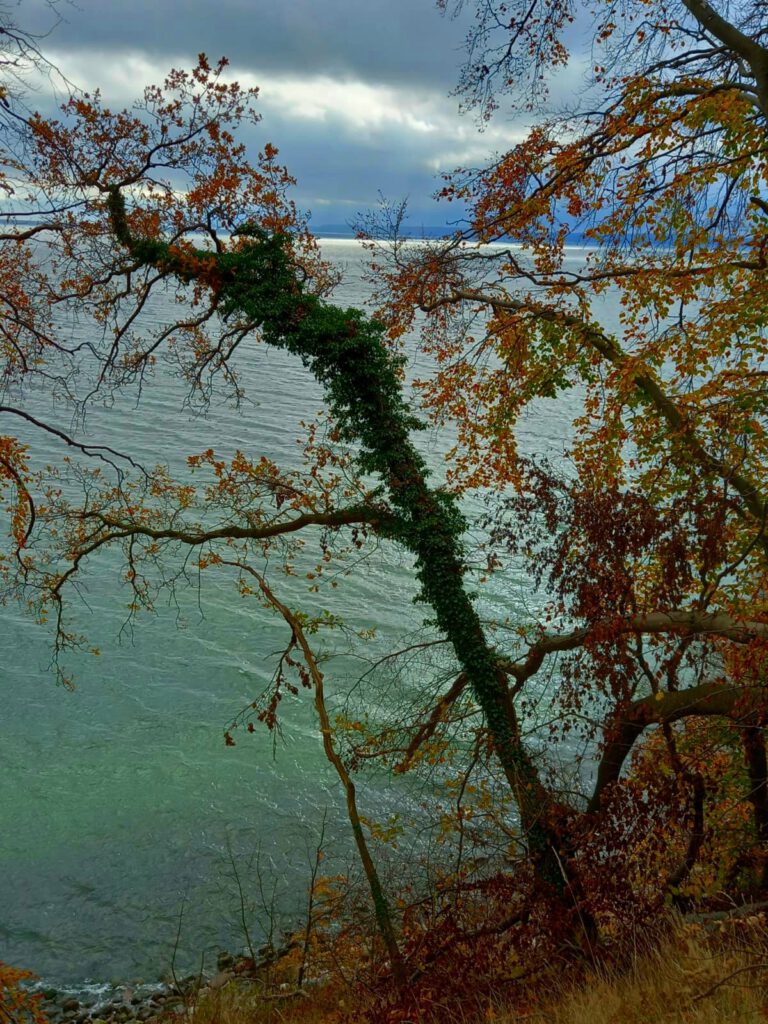
My soul tree on Rügen - sea view - my inspiration for my picture Metempsychosis

“Senta” – Richard Wagner’s opera “The Flying Dutchman”


A bit like a fairy tale, but also spooky and dramatic: the story of the Flying Dutchman. Every seven years, the "Flying Dutchman," captain of a ghost ship, is allowed to leave his ship and search ashore for a woman who will release him from his curse. Only if this woman loves him unconditionally and remains faithful to him can he and his crew hope for redemption and finally die.

Senta, the daughter of the Norwegian merchant Daland, is deeply touched when she hears the story of the Flying Dutchman for the first time. One day she comes face to face with the captain. Not surprisingly, the dreamy girl immediately believes that she must be the chosen one who alone can save the ghost captain. Erik, a hunter who is in love with Senta, tries to dissuade her from her conviction. But Senta wants to follow the captain.

The Flying Dutchman sees Senta together with Erik and assumes that she has decided against him. Disappointed, the captain orders his sailors to set sail and sails away with the ghost ship.

Senta wants to rush after him and prove her loyalty. She climbs a rock - and plunges into the sea.

Ölmalerei, 120 x 150

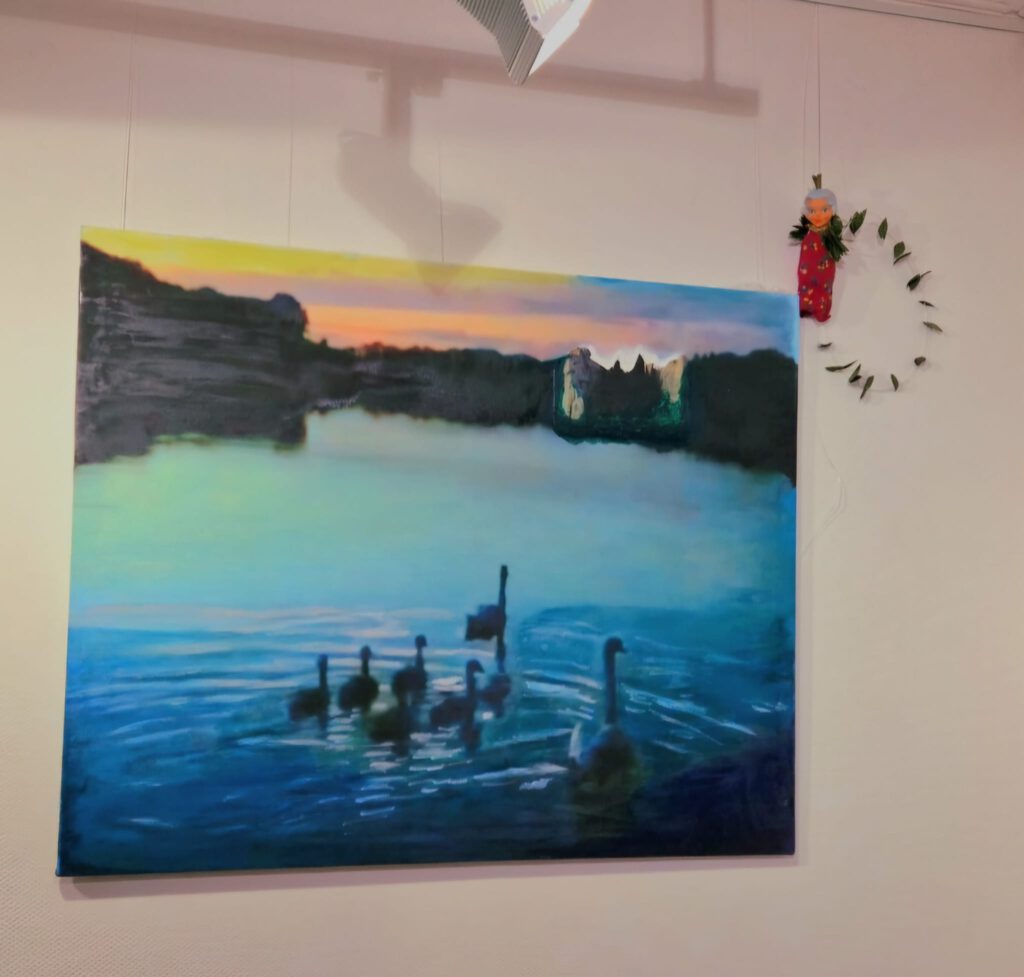
The wild Swans


A king has eleven sons and one daughter, Elisa. Their new stepmother curses the princes and turns them into swans; only at night can they take on human form.

Elisa finds her brothers and learns that they can only be redeemed if she weaves eleven shirts from nettles. While weaving, she must not speak a word, otherwise her brothers would die.

Elisa suffers pain when she picks the nettles and has to endure great hardship to complete the shirts.

When the shirts are almost finished, Elisa is accused of witchcraft and sentenced to death. At the last moment, the swans arrive and Elisa is able to put the last shirts on them.

The youngest brother is missing a sleeve on his shirt, which is why he keeps a swan's wing. Elisa is allowed to speak, prove her innocence and the evil queen is punished.

Öl-Misch-Technik, 120 x 150

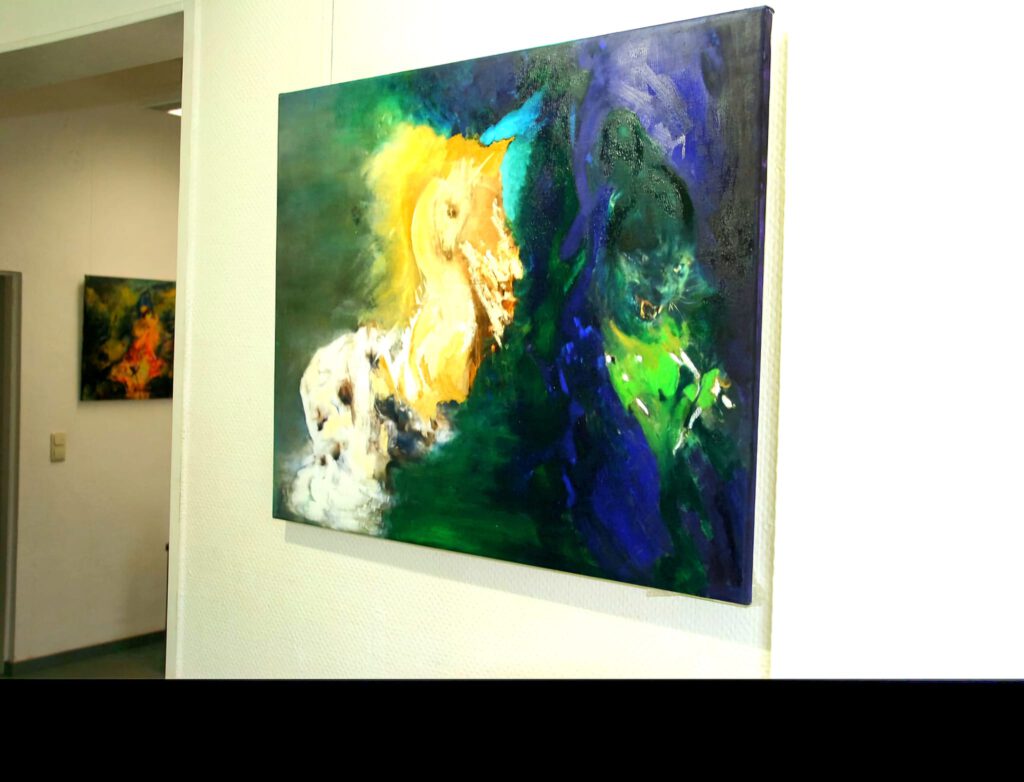
The Unicorn


The saint raised his head, and the prayer
fell back from his head like a helmet:
for silently approached the never-believed,
the white animal, which, like a stolen,
helpless doe, implores with its eyes.

The legs of the ivory frame
moved in light balance,
a white sheen glided blissfully through the fur,
and on the animal's forehead, quiet and light,
stood the horn, bright as a tower in the moonlight,
and every step was taken to raise it.

The muzzle with its pink-grey down
was slightly gathered, so that a little white
(whiter than anything) shone from the teeth;
the nostrils took in and panted softly.
But its gaze, which nothing limited,
cast images into the room
and closed a blue circle of legends.

Rainer Maria Rilke


The Panther

His gaze has grown so weary from watching the bars pass by that he can no longer hold anything. It is as if there were a thousand bars and behind a thousand bars no world. The soft gait of supple, strong steps, turning in the smallest of circles, is like a dance of power around a centre, in which a great will stands numb. Only sometimes does the curtain of the pupil slide open silently – then an image enters, passes through the tense silence of the limbs – and ceases to be in the heart.

Rainer Maria Rilke, Im Jardin des Plantes, Paris, 1903

Öl-Misch-Technik, 80 x 65

The Little Match Girl


On the last evening of the year, a poor little girl runs barefoot and bareheaded through the streets. She has lost her mother's slippers. Her feet are red and blue with cold. She carries a lot of matches in her apron. All day long, no one wanted to buy a match from her or give her any money. And so the girl runs through the cold night, hungry and half frozen.

She sits down in a corner between two houses and curls up. The girl doesn't dare go home because she hasn't sold a single match all day. She is afraid of being beaten by her father, and besides, it is cold and draughty there. The girl takes one of the matches from her hand and lights it against the wall of the house. The flame glows brightly and warmly. She dreams of a stove with a warm fire burning in it. As she reaches out to put her feet near the stove, the burnt match in her hand goes out.

She lights another match on the wall. Where the wall had been just a moment ago, the girl now sees a table set with expensive porcelain and a delicious steaming goose stuffed with plums and apples. The goose jumps off the table and waddles towards the girl. Then the match goes out and all that remains is the thick, cold wall.

Once again, the girl lights a sulphur match and sees a beautifully decorated Christmas tree in front of her. As she reaches out her hand towards the thousands of lights on the green branches, the sulphur match goes out. Her gaze wanders to the stars in the sky. One of the stars falls, leaving a long trail of fire across the sky. The girl remembers her grandmother telling her that this means a person is dying and their soul is ascending to God.

The girl lights another sulphur match on the wall of the house and everything around her glows and shines. Her old grandmother stands before her. The girl asks her grandmother to take her with her. She lifts the girl into her arms and, in splendour and joy, they both ascend, feeling no cold, no hunger and no fear. They are with God.

The next morning, a small, smiling, dead girl sits in the corner between two houses. She wanted to warm herself, people say, not realising the splendour in which she has entered into the New Year's joy with the old grandmother.

Hans Christian Andersen

Öl-Misch-Technik, 80 x 65

A loon swims towards the midnight sun ... Summer solstice

BIRDS have a diverse colour perception. Unlike mammals, each individual receptor in birds is equipped with an oil droplet that acts as a colour filter and filters out certain wavelengths of light. For their study, the scientists examined the oil droplets attached to the various receptors in the retinas of chickens. With their help, they were able to identify how the individual sensory cells are distributed.

The team led by physician Joseph Corbo reports on its findings in the journal ‘PLoS one’. In addition to the receptors for perceiving red, green and blue, which are also present in humans, birds have an additional receptor for violet. Its sensitivity extends into the ultraviolet range. The animals also have a special receptor for perceiving movement.

‘If we ever want to understand the diversity of colours in nature, we must undoubtedly also understand how animal species differ in their colour perception.’

Ölmalerei, 100 x 80

Life's illusion


One of my favorite quotes comes from Abhijit Naskar, author of "Love, God & Neurons: Memoir of a Scientist Who Found Himself Getting Lost."

He said: "Time is basically an illusion created by the mind to support our sense of temporal presence in the vast ocean of space. Without the neurons creating a virtual perception of the past and the future based on all our experiences, there is no actual existence of the past and the future.

All there is is the present."

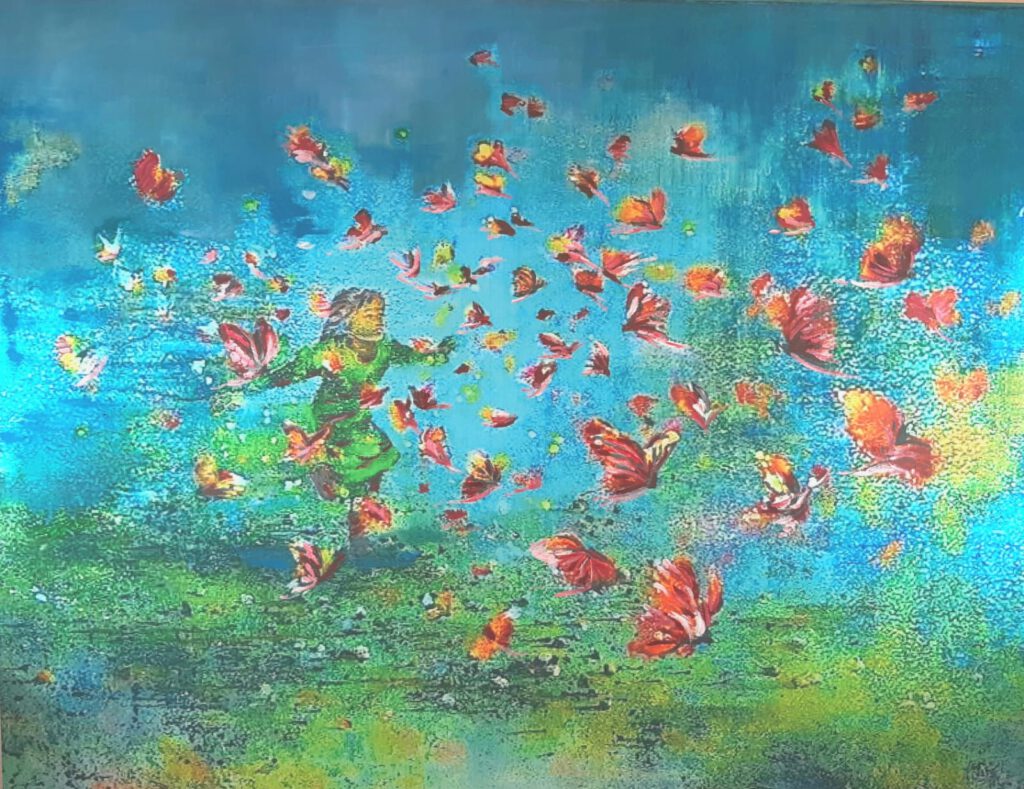
Girl with lucky butterflies